
Understanding Latah County Releases
“Released” describes the end of one custodian's control, but it does not always mean a person went home. Latah County now uses a split process. The courthouse operation in Moscow handles court-hours holding and booking, while many people who do not post bond or who arrive after hours are housed at the Nez Perce County Adult Detention Center in Lewiston. A transfer between those places removes a name from one view without ending custody. The first task is therefore to identify the agency that held the person at the time of the event.
Several records may survive after the live roster changes. The jail custodian may hold a booking sheet and movement or release entry. The court file can show a bond order, judgment, dismissal, sentence, probation order, or warrant. The Idaho Department of Correction, or IDOC, keeps a separate record for state prison and felony community supervision. VINE provides event notices, not a permanent archive. Each source answers a different part of the Latah County release question.
- Release
- The end of custody at a named facility, either to the community or to another authority.
- Parole
- Conditional community release from the prison part of a sentence.
- Probation
- Court-ordered supervision that may exist without a prison release.
- Discharge
- The end of the sentence or IDOC jurisdiction shown in the state record.
Latah County Release Types
The event label controls where to look next. Bond ends pretrial confinement, but the case continues. Time served or sentence completion ends the stated custody term, subject to any other hold. A dismissal concerns a charge or case and may not describe the exact time a person left a jail. Parole moves a state prisoner into supervision, while probation is imposed by a court. A transfer to IDOC, the United States Marshals Service, another county, or immigration custody is not a community release.
| Release event | Meaning | Best next record |
|---|---|---|
| Bond or court release | Pretrial jail custody ends; the case remains open. | Jail movement entry and iCourt order |
| Time served | The stated jail term ends, unless another hold controls. | Judgment, credit calculation, and release entry |
| Parole | State prison custody changes to supervised community status. | IDOC detail and Commission record |
| Probation | A court places the person under community supervision. | iCourt judgment and IDOC status |
| Transfer | One facility releases the person to another custodian. | Movement record naming the receiving agency |
| Discharge | IDOC jurisdiction shown in the search has ended. | IDOC “Discharged” status and date |
Death also ends custody, but it must not be described as an ordinary release. When a record uses an unclear code, ask the custodian to explain the maintained field rather than assigning a more favorable meaning. The same caution applies to “not found.” That result can reflect transfer, a spelling change, confidential status, a site delay, or a different custody system.
Latah Release Record Fields
The public Latah current roster is useful for matching a booking. Observed cards include a name, booking date and time, booking number, court case number, bond, offense details, and a photograph. Research found no public release date or release-reason field on that view. The stronger record after departure is the custodian's movement or release entry, requested for the exact booking and date range.
| Requested field | What it can establish |
|---|---|
| Name and booking number | Connects the event to the correct booking. |
| Admission date and time | Defines the start of that custody period. |
| Releasing facility | Identifies whether Moscow, Lewiston, IDOC, or another system acted. |
| Release or transfer time | Shows when that custodian's control ended. |
| Authority or event type | Distinguishes bond, court order, sentence completion, or transfer. |
| Destination agency | Shows whether another custodian received the person. |
| Case and charge numbers | Provides the key for matching the iCourt trail. |
| Booking photograph | Helps identify the correct booking if lawfully released. |
The list is request language, not a promise that every field exists or is public. The custodian may redact an exempt part while releasing the rest. A court order and a jail exit record should be paired when the distinction between legal authority and physical departure matters. The court order can authorize release, while a separate hold or processing step may delay or redirect the actual movement.
Request Latah County Release Records
The Latah Sheriff's Records Office requires written requests and is the practical first contact for county booking material. It is at 522 S. Adams Street in Moscow and can be reached at 208-883-2266 or 208-882-2216. Public hours are 7:00 a.m. to 4:00 p.m. Monday through Thursday and 7:00 to 11:00 a.m. Friday, excluding holidays. No specific release-record or booking-photo fee is posted on the reviewed page.
- Identify the person with full name, booking number, case number, and a narrow date range.
- Ask for the booking sheet, custody movement or release record, release type and destination, and booking photo.
- Request electronic, segregable nonexempt portions and ask that each withholding cite its statute.
- Send a separate request to Nez Perce if that jail created the custody or release event.
- Use IDOC's public-information portal when the requested event is a prison release, supervision placement, or discharge.
Under Idaho Code § 74-103, the resident response baseline is three working days, with a written extension to no later than ten working days. The statute provides longer periods for nonresidents. Idaho residents ordinarily receive the first two labor hours and 100 pages without charge under § 74-102 before eligible actual costs may apply. Ask for an estimate before work that may cost money.
Latah Release Records and Idaho Law
Idaho Code § 74-102 begins with a presumption that public records are open unless an exemption applies. Correctional security, protected victim or witness details, future movement, presentence material, and other statutory limits can restrict a response. A narrow request for a completed Latah County release event is more useful than a broad demand for operational or future-movement information. Ask for the rest of a record when only one part is exempt.
Retention differs by system. Neither the Latah roster nor the Sheriff's records page publishes a former-booking display period. The public iCourt trail often lasts beyond a jail stay, subject to court access rules. IDOC says people who satisfied a sentence remain named in its search, although convictions do not appear in that discharged presentation. VINE is a notification service rather than a historical archive.
A dismissal is not the same as expungement. Idaho Code § 19-2604 provides forms of relief in qualifying cases, but it does not erase every agency record. Clean Slate shielding under § 67-3004 can make eligible records unavailable for public viewing without destroying all authorized official access. Court files are chiefly governed by Idaho Court Administrative Rule 32. The clerk is the right source for the status of a particular public court file.
How Latah Bond Release Works
The Sheriff's legacy bond instructions describe a local sequence tied to court hours. During court hours, payment went to the clerk and the receipt went to the Sheriff. After hours, the instructions directed payment to the Sheriff's front window or use of a bondsman. They also list a separate $10 after-hours and weekend processing fee. That is useful historical procedure, but the 2025 custody transition means callers should confirm where the person is held and whether the old payment route still applies.
Bond is not a case dismissal. It ends that pretrial confinement when processing is complete and no other hold controls. Keep the receipt, identify the booking, and later match the release entry with the court's bond order. If the person has already moved to Nez Perce County, ask which office accepts the payment and where physical release will occur before traveling.
When Latah Jail Release Finishes
Older Latah instructions estimate 30 to 60 minutes for booking and about another 30 minutes for bond paperwork and release, with longer waits when problems or workload intervene. They identify the Sixth Street entrance as the old exit. Those details predate the change to court-hours holding and contract custody. They are not a current promise.
Call the facility that actually holds the person before arranging a pickup. Confirm the release authority, whether another hold exists, and which public exit is used. Staff may be able to give operational guidance, but a later written movement entry is the durable proof of the event. Never wait at a secure exit without confirming the permitted public area.
Note: A court order can authorize release before the jail finishes checks, paperwork, property return, and any transfer decision.
Getting Home After Latah Release
A Latah detainee may leave custody in Lewiston instead of Moscow. The Sheriff's transition announcement routes many after-hours and non-bond detainees to Nez Perce County, and independent 2026 reporting describes the trip as roughly 45 minutes. Research found no current official jail-to-home transportation program. A pickup plan should therefore start with direct confirmation of the facility, exit, event type, and likely processing window.
A transfer is a different event. If Nez Perce says the person left for court, IDOC, a federal authority, immigration custody, or another jail, do not arrange a community pickup based only on roster absence. Ask for the receiving agency and request the movement entry from the office that maintains it.
Find Released Latah County Inmates
Start with identity and custody type. A full legal name, alias, birth year, approximate arrest date, booking number, and court case number reduce bad matches. Then check both county systems. The Latah roster reports current local bookings, while the Nez Perce In Custody page covers the contract jail but warns that its reports can lag. Neither is a historical list of Latah County released inmates.
- Search Latah current custody and save the booking and case numbers.
- Check Nez Perce, then call 208-799-3132 because the agency directs current-status confirmation by phone or in person.
- Search IDOC for prison, parole, felony probation, or discharged status.
- Use iCourt to read the public bond, judgment, sentence, dismissal, probation, or later warrant trail.
- Check VINE prospectively and verify any alert with the named custodian.
- Request the movement or release record from the agency that created it.
- Use BOP or ICE only when the record points to federal or immigration custody.
Two-source confirmation is strongest. Examples include a jail movement entry plus a court order, an IDOC “Discharged” date plus an official information response, or a VINE event followed by direct facility confirmation. The Latah County 24-Hour Releases page explains the same-day fallback when no official released-person feed exists.
IDOC Search for Latah Releases
The IDOC Resident/Client Search covers state incarceration, parole, court probation under IDOC, and satisfied sentences. It does not document a short county-only jail stay. Search by last name with an optional first name, or by IDOC number. Compare the ID number, name, birth year, and status before deciding that a result belongs to the person sought.
| Search item | Rule or meaning |
|---|---|
| Last name | At least two characters are required for a partial search. |
| First name | Optional field used to narrow a common surname. |
| IDOC number | The first three digits can begin a number search. |
| In custody | IDOC still reports state confinement. |
| In community | The person is outside prison but remains under IDOC jurisdiction. |
| Discharged with date | The clearest public marker that the shown IDOC jurisdiction ended. |
| Active Bench Warrant | Not release proof; separate arrest and custody confirmation are needed. |
The search says it updates daily, yet status, location, and scheduled termination information can change faster. A “Discharged” date is an IDOC status date, not the exact time a person left Latah County custody. “Released to Supervision,” parole eligibility, tentative parole date, and sentence satisfaction are different milestones.
The official IDOC result display shows how status labels separate a discharged person from someone in the community under supervision.
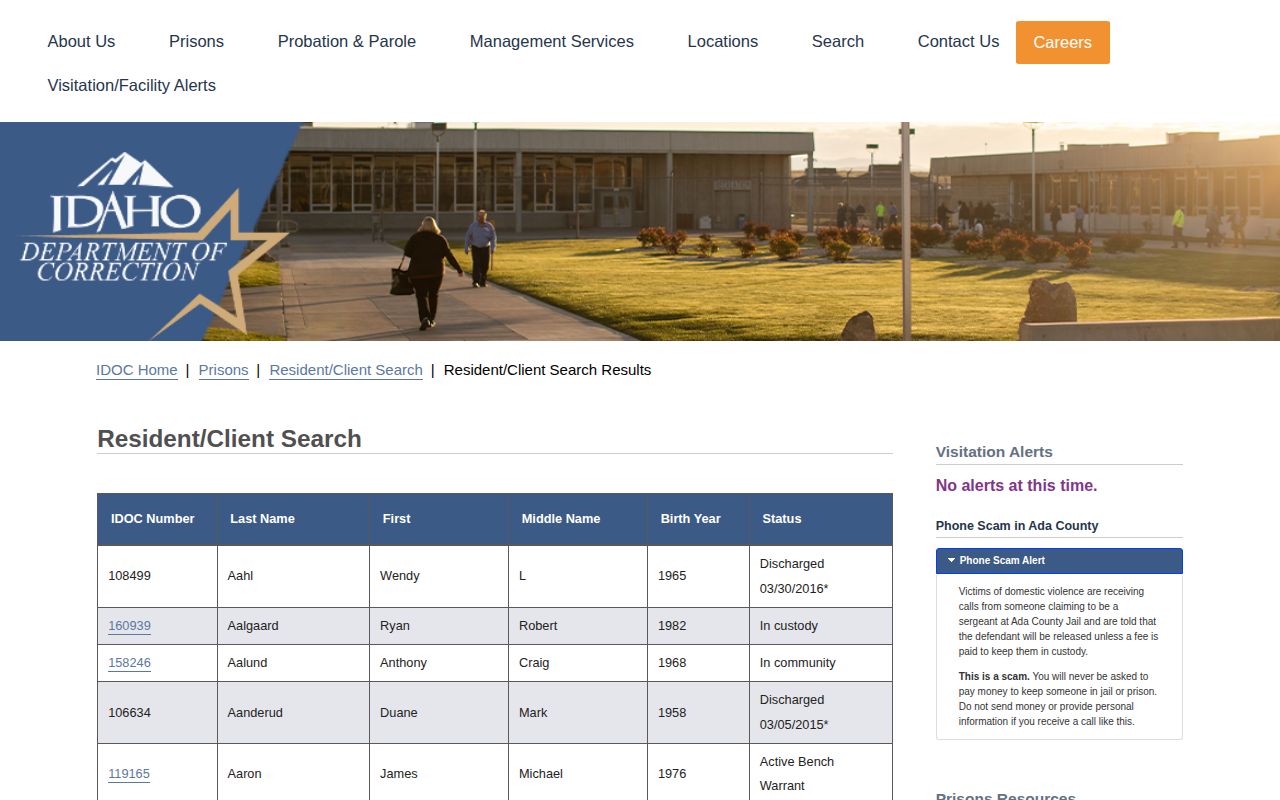
Read the label as published, then seek an IDOC record when formal proof or a same-day correction is needed.
Latah Release Orders in iCourt
The Idaho iCourt portal provides the durable case trail after a roster entry disappears. Use the case number from the booking card when possible. Public entries may show bond, disposition, judgment, sentence, probation, dismissal, warrant, or satisfaction. They do not always show the exact moment a person walked out of a facility.
Latah's court structure creates an added wrinkle. Magistrate handles misdemeanors and the early probable-cause or preliminary stages of felony matters. District Court generally holds the later felony disposition and sentence. A felony release order may therefore appear in the Magistrate trail while the final outcome rests in District. The local Court Assistance office is closed until further notice and does not serve post-conviction criminal matters, so iCourt and the Latah District Court clerk are the practical public-record routes.
The clerk is at 522 S. Adams Street, Suite 119, Moscow, and can be reached at 208-883-2255. Ask by case number for the public bond or release order, judgment, sentencing entry, and later satisfaction or discharge document. Pair the result with the jail movement record.
Latah Release Supervision Status
Idaho separates release decisions from supervision. The Idaho Commission of Pardons and Parole decides discretionary parole and revocation matters. IDOC Probation and Parole supervises parole and felony probation. A person listed “In community” may be outside prison but still under state jurisdiction. Full discharge is different.
Latah belongs to IDOC District 2. The main office is in Lewiston, and IDOC also lists a Moscow satellite. Verify the public IDOC number and status before asking the district office whether the published supervision assignment is current. Do not seek a private address or confidential plan. The Latah County Post-Release Supervision page distinguishes parole, probation, warrants, and discharge.
Latah Help After Release
IDOC's reentry directory lists Latah Recovery Center. The center describes peer recovery support, coaching, groups, harm-reduction services, and crisis-network access at 531 S. Main Street in Moscow. Some help is free or offered at cost. It is a support resource, not a records office.
Do not ask the center to confirm custody, release, parole, or probation. Those questions belong with the actual jail, court, IDOC search, or District 2. The distinction protects both privacy and accuracy while still pointing a released person or family toward local support.
Latah Release Alerts and Transfers
Idaho VINE allows a specific-person custody search and notification registration. Select Idaho, compare identifiers, open the correct record, and choose the offered notification channel. An alert reports what a participating source sent. Because a Latah booking may move to Nez Perce, an out-of-custody event must be checked with the facility before it is called a release home.
Federal paths are separate. The BOP Inmate Locator covers federal inmates from 1982 onward and can display “Released” or “Not in BOP Custody.” That does not rule out local, state, immigration, or supervised-release status. ICE's current detainee locator covers immigration custody and is not a historical release archive. A USMS movement from a county jail is a transfer until the federal path confirms otherwise.
Where Latah Release Status Appears
No single portal covers all Latah County released inmates. Choose a source by custody population and by whether the question concerns current custody, an actual past event, community supervision, or the end of jurisdiction.
| System | Still in custody | After release or transfer |
|---|---|---|
| Latah roster | Current local booking card | No official release archive; request the event |
| Nez Perce report | Contract-jail view with stated lag | Call or visit, then request its movement record |
| IDOC search | “In custody” | “In community” or “Discharged” with date |
| iCourt | Orders and live case trail | Disposition, sentence, probation, or later orders |
| VINE | Status and prospective alerts if supplied | Event notice, subject to direct verification |
| BOP locator | Federal location/status | Released or not in BOP custody, with caveats |
| ICE locator | Current immigration detention | No result is not historical release proof |
Latah County Release Facilities
The local path begins with Latah County Detention Center, now described by current research as a court-hours holding and booking operation. Nez Perce County Adult Detention Center houses many after-hours and non-bond Latah detainees. State prison cases move into the statewide Idaho Department of Correction network, while District 2 Probation and Parole handles local community supervision.
Federal sentences use the Federal BOP Inmate Locator. Immigration transfers use the ICE Detainee Locator. No BOP prison or ICE detention center was identified within Latah County, so those pages explain network searches rather than a local jail.
Search Latah County Records
Sponsored Results