
Latah County Parole and Probation
Idaho separates release decisions from community supervision. The Idaho Commission of Pardons and Parole decides discretionary parole and handles revocation matters. Idaho Department of Correction Probation and Parole supervises both people released on parole and people placed on felony probation by a court. Neither label means the sentence has ended.
Parole is conditional community release from the prison part of a sentence. Probation is a court-ordered sentence or status, often imposed without a state-prison release. A county jail exit alone does not establish either one. The Latah court case and the IDOC record show which authority applies.
| Status | Who orders it | What it means |
|---|---|---|
| Parole | Idaho Commission | Conditional release from prison while IDOC jurisdiction continues |
| Felony probation | Sentencing court | Community supervision ordered by the court |
| Discharge | Shown in the completed IDOC record | The displayed sentence or supervision has been satisfied |
- In community
- An IDOC status generally showing supervision outside prison.
- Released to Supervision
- The most recent date a court or Commission placed the person under supervision.
- Discharged
- The clearest public IDOC marker that the shown jurisdiction ended.
- Absconder
- A person alleged to have stopped reporting or complying. It does not by itself prove a new arrest.
Check Latah County Supervision Status
The official public route is the IDOC Resident/Client Search. It includes people in prison, on parole, on felony probation under IDOC, and people who satisfied an IDOC sentence. Search by last name with an optional first name, or by IDOC number. A partial surname needs at least two letters. An IDOC-number search needs at least the first three digits.
Compare the IDOC number, full name, birth year, sentencing county, and case number before drawing a conclusion. Some people have more than one IDOC number. A name alone is weak evidence, especially when it is common. The search is updated daily, but IDOC warns that status, location, and scheduled termination details can trail a fast change.
- Gather the legal name, birth year, IDOC number if known, and Latah County court case number.
- Search the state tool and compare every available identifier.
- Read the status literally. “In community” is not discharge, and “Active Bench Warrant” is not proof of custody.
- Open the detail record for released-to-supervision, sentence, office, and satisfaction information that is publicly shown.
- For a fresh or unclear event, call District 2 and request releasable confirmation through the proper IDOC records process.
The Latah jail roster covers current local bookings, not statewide parole or probation. A person housed at Nez Perce County under Latah's contract arrangement may also disappear from one county list due to transfer. State supervision should be verified in the state record, then checked against the Latah case in iCourt.
The official interface shows how state status is organized. The IDOC results source uses distinct labels for custody, community status, warrants, and discharge.
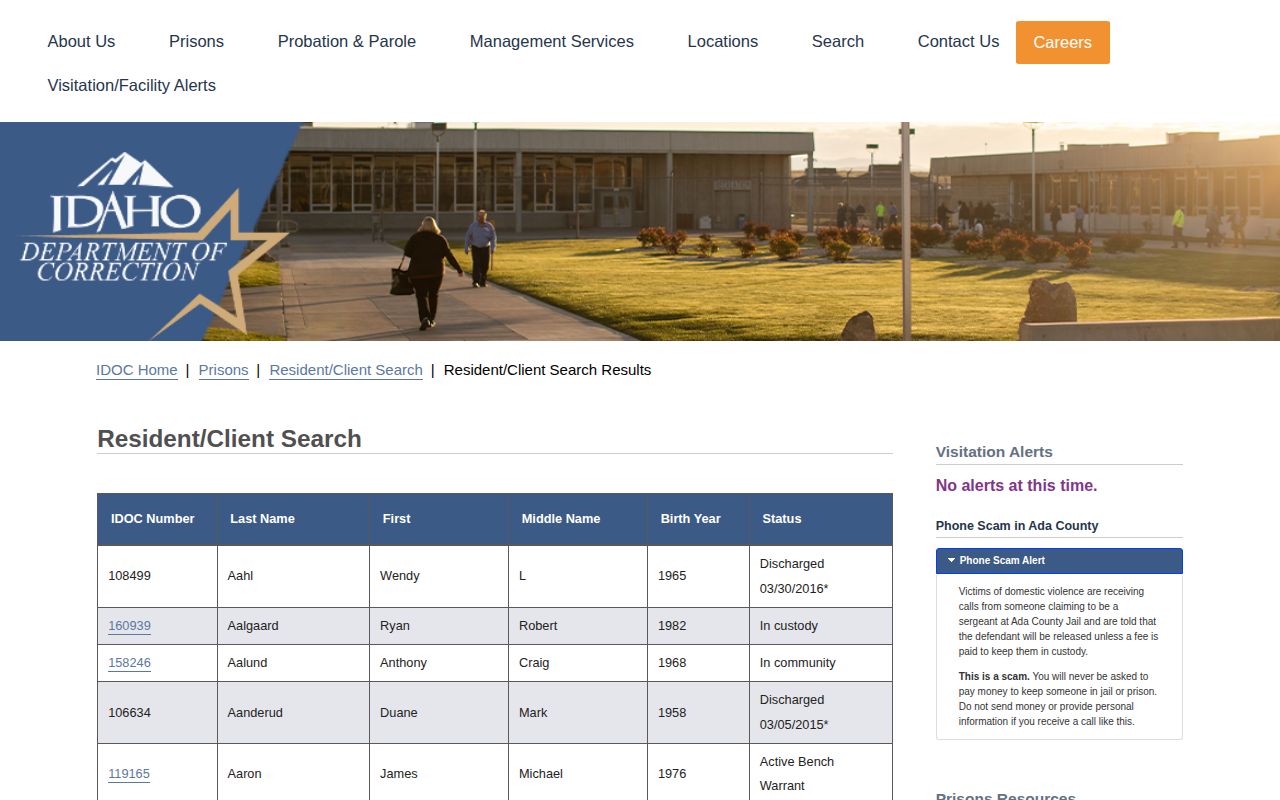
Those labels should be quoted as displayed. They should not be converted into a claim about a person's exact physical location.
Latah County District 2 Office
Latah County belongs to IDOC District 2, which follows Idaho's Second Judicial District and serves Clearwater, Idaho, Latah, Lewis, and Nez Perce Counties. The main office is in Lewiston. A Moscow satellite provides a closer administrative location, but the official directory does not publish a separate Moscow telephone number.
IDOC District 2 Probation and Parole908 Idaho Street
Lewiston, ID 83501
208-799-5030
For the satellite, the official District 2 page lists 1350 Troy Highway, Suite 3, Moscow, ID 83843, and fax 208-882-0428. Use the Lewiston main number when a recent Resident/Client Search entry needs clarification. Give staff the IDOC number and public identity details. Ask whether the public record correctly reflects in-community supervision and how to request a releasable status record.
Do not treat an office listing as proof that someone is physically at that address. It shows an administrative assignment. Staff should not be asked for a private home address, confidential case plan, or future movement detail.
Latah County Parole Hearing Records
A parole eligibility date is the earliest point at which parole can be considered after the fixed portion of Idaho's unified sentence. It is not promised release. The Commission posts a live hearing schedule weekly. Dates and times can change, and the schedule identifies the hearing type, name, and IDOC number. Incarcerated participants attend virtually. Public or supporters attend through the Commission office, and supporter testimony requires advance notice under the posted instructions.
The schedule is useful for identifying a pending decision, not proving a completed release. A hearing can result in a grant, denial, continuance, deferral, review, or revocation-related action. The hearing and review decisions page generally posts a Notice of Action Taken by the end of Friday after the person's hearing.
The Commission's schedule shows the state process that may precede Latah County post-release supervision.
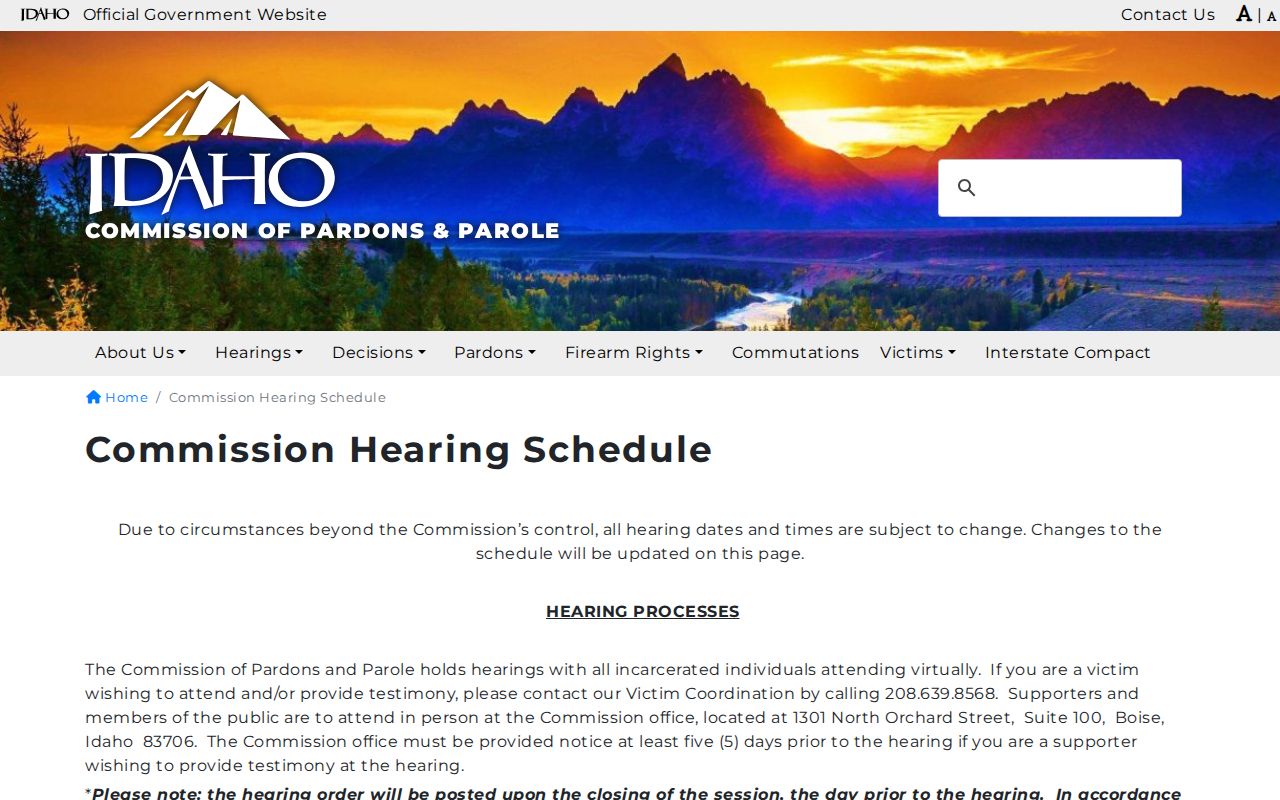
A listed hearing or decision must be paired with a later IDOC community-status change or formal release record before it is described as an actual release.
When Latah County Parole Starts
A tentative parole date remains conditional. Required programming must be complete. IDOC must investigate and approve the parole plan, and final paperwork must be processed. The Commission can change or void the date. Idaho law supplies no presumption, expectation, or right to discretionary parole.
Actual release is better supported by a changed IDOC status, a released-to-supervision entry, a facility event, or a formal IDOC record. A court order or Commission action provides legal authority, but processing and other holds can delay or redirect physical movement. This distinction matters in Latah County because a person may be housed in Lewiston, moved to IDOC, or held for another authority.
Latah County Warrants and Absconders
An “Active Bench Warrant” or reported absconding status is not the same as a return to custody. It signals an unresolved court or supervision issue until an arrest and booking are separately confirmed. The state record, the court warrant trail, and a current facility check answer different parts of the question.
No authoritative Latah Sheriff public absconder list was located. Use IDOC status, iCourt, and direct agency confirmation. Absconding may also affect a calculated full-term date under current Idaho law, including Idaho Code § 20-1007. The precise legal effect belongs to the sentence record, not a guess based on the date a warrant appeared.
VINE can add a custody-event alert where the relevant agency participates. It cannot establish that supervision ended, and an out-of-custody notice does not rule out transfer or another hold.
Latah County Reentry Support
IDOC's reentry directory lists Latah Recovery Center. The center describes peer recovery support, coaching, groups, harm-reduction services, and access to a regional behavioral-health crisis network at 531 S. Main Street in Moscow. Some support is free or offered at cost.
The center is a support resource. It is not a custody, parole, probation, or release-record office. Questions about supervision status belong with IDOC District 2, while court orders belong with the Latah County clerk.
Confirm Latah County Discharge
Supervision ends when the controlling sentence and legal requirements are satisfied, not merely when someone leaves jail or prison. In the public state search, “Discharged” with a date is the clearest historical completion marker. IDOC cautions that a satisfied-sentence result may retain only the name while omitting conviction details.
A formal need may call for an agency-maintained discharge or sentence-satisfaction record. IDOC's public information request route is appropriate for the state computation and supervision record. The Latah court case can separately show judgment, probation, violation proceedings, and later satisfaction entries. The county release record proves a jail exit, but it does not prove that state supervision ended.
Use the Latah County released-inmate search path to reconcile jail, court, and state records when the custody history crosses systems.