
IDOC Release Status Meanings
The Idaho Department of Correction is a statewide prison and community-supervision system. No state prison was identified within Latah County. A person sentenced in Latah can leave county-jail custody through transfer to an IDOC institution elsewhere. That movement is not a release to the community. Once IDOC assumes jurisdiction, the statewide Resident/Client Search becomes the correct public lookup.
| IDOC status | What it establishes |
|---|---|
| In custody | IDOC reports state correctional confinement. |
| In community | The person is generally outside prison but remains under IDOC jurisdiction. |
| Active Bench Warrant | A warrant issue affects community status; it is not proof of completed release. |
| Discharged [date] | The displayed IDOC sentence or supervision has been satisfied. |
These labels do not reconstruct a short county-only detention. Likewise, a Latah roster cannot prove the end of a state sentence. County release and state discharge records have different custodians and scopes.
Search IDOC Release Records
IDOC calls its public tool Resident/Client Search. Search by last name with an optional first name, or use an IDOC number. A partial last name needs at least two characters. An IDOC-number query needs at least the first three digits. Results provide the IDOC number, name, birth year, and current published status.
- Open Resident/Client Search and review the data warning before searching.
- Enter the IDOC number when known, or a last name and optional first name.
- Compare the name, middle name, birth year, and IDOC number before choosing a result.
- Read the status as published. Do not convert “In community” into “Discharged.”
- Open the detail record for location, sentence, and scheduled milestone fields when available.
- Confirm a same-day change with IDOC records or the supervising office.
The official IDOC Resident/Client Search presents the inputs and update warning. Its matched source image shows the correct statewide interface:
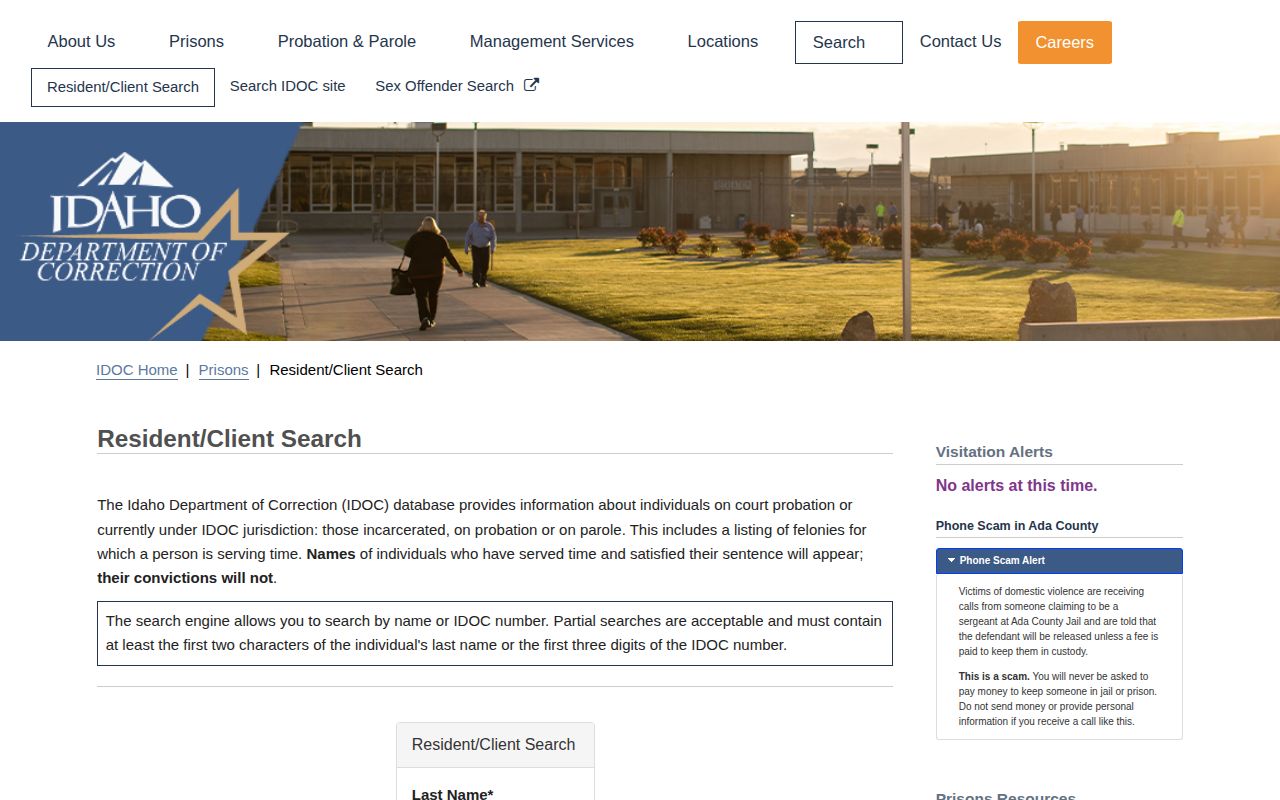
The interface covers state correctional jurisdiction, not ordinary Latah or Nez Perce bookings that never became IDOC cases.
IDOC Discharge and Community Results
“Discharged” plus a date is the clearest historical completion marker in the public IDOC results. IDOC says people who served time and satisfied their sentence can remain searchable, though convictions may no longer display. “In community” has a different meaning. It ordinarily points to parole or court probation under IDOC, so the person is not in prison but is not yet fully discharged from that jurisdiction.
The IDOC results page demonstrates these status forms. The successful manifest capture shows discharged and community entries:
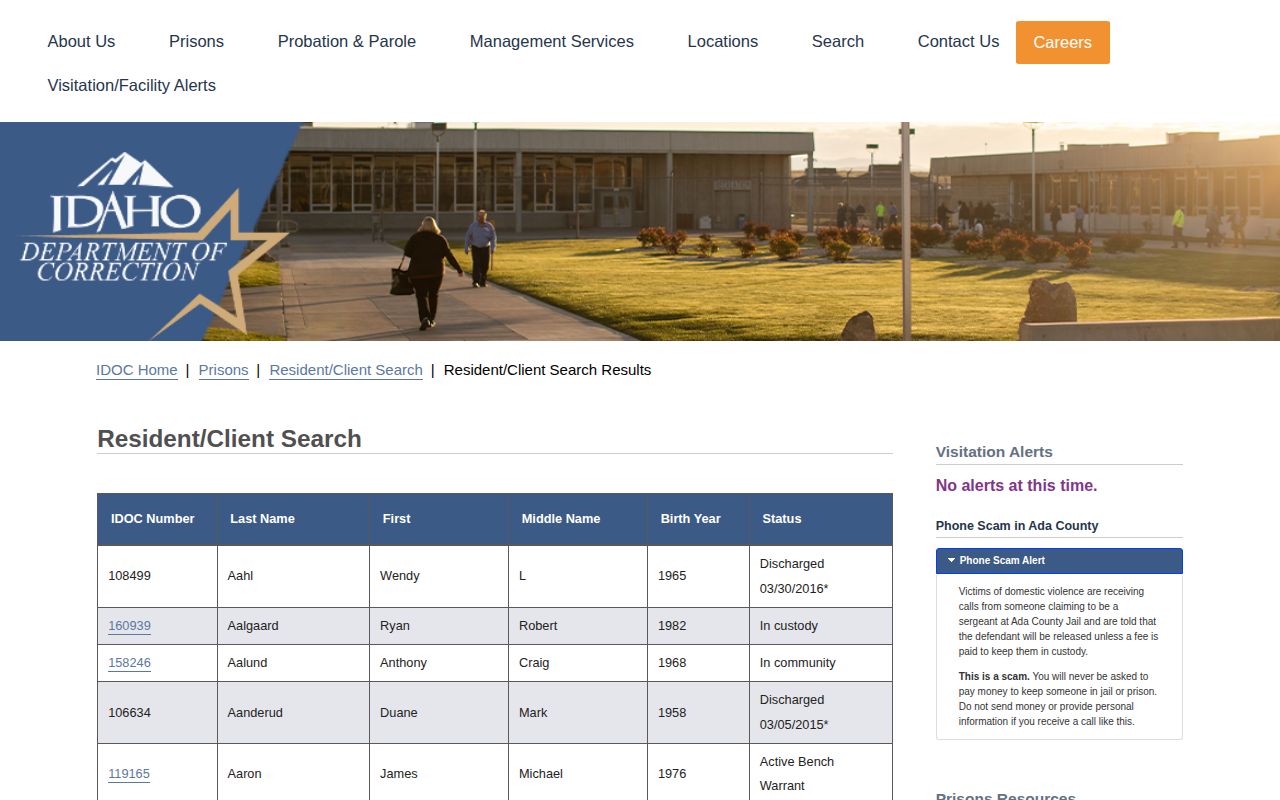
The result is strong public evidence, yet it is not a certified discharge document and does not supply the exact door-out time from a Latah County facility.
IDOC Dates Are Not Releases
A detail record can contain scheduled termination or full-term information, parole eligibility, or tentative milestones. Each answers a different question. A parole eligibility date marks when the indeterminate portion of an Idaho unified sentence begins and parole can be considered. It does not order release. A tentative parole date also remains conditional on program completion, an approved plan, final paperwork, and other requirements.
- Parole
- Release from prison into supervision before the sentence or jurisdiction fully ends.
- Probation
- Court-ordered community supervision, often imposed instead of prison or after retained jurisdiction.
- Tentative date
- A conditional milestone that can change and is not proof the person left custody.
- Discharge
- The end of the IDOC jurisdiction shown in the public result.
Actual movement can change because of sentence computation, earned credit, disciplinary loss, a detainer, a court order, or a parole decision. A future field should never be cited as proof of completed release. VINE notification, the IDOC status, and the official record can be compared after the event.
IDOC Records and Contact
Resident/Client Search gives basic public information. When a certified or fuller record is needed, direct the request to IDOC rather than the Latah Sheriff. IDOC Sentencing Records reviews judgments, calculates sentences, applies jail or retained-jurisdiction credit, processes parole forfeitures, and maintains sentencing data. The county remains the custodian of its own booking photograph and local movement entry.
Idaho Department of Correction Central Office1299 N. Orchard Street, Suite 110
Boise, ID 83706
208-658-2000
Use the IDOC public records portal. Identify the person by full name and IDOC number, give a narrow date range, and name the existing records requested, such as status history, discharge record, sentence computation, or transfer entry. Asking for records is more precise than asking staff to create a legal explanation.
Idaho Title 74 applies, subject to correctional and other exemptions. Security-sensitive future movement, protected victim information, and some correctional material can be withheld. Ask for segregable nonexempt portions and a statutory explanation when part of a record is denied.
Latah Cases Entering IDOC
A person can disappear from the Latah or Nez Perce roster because IDOC took custody after sentence. That is a transfer between systems. Start with the Latah court case to confirm the sentence and commitment. Then use the statewide IDOC number or name search. If the person later leaves prison on parole, the public status may move to “In community.” District 2 handles community supervision for Latah County.
The records form an evidence chain. The county movement entry shows when the local jail handed off custody. The judgment explains the legal sentence. IDOC shows state custody, community supervision, or discharge. A Commission decision may show a grant or tentative date, but actual release still depends on final correctional processing.
The full Latah County released-inmate records route is useful when the question begins before IDOC admission or involves a local court order. Do not treat the current county roster as a prison-release search.
IDOC Release to District 2
People released from an IDOC prison to parole may return to the community under District 2 supervision. A person on felony probation may also appear “In community” even without a prison release. The statewide record should be checked before assuming that absence from prison means the person is no longer supervised.
IDOC District 2 Probation and Parole908 Idaho Street
Lewiston, ID
208-799-5030
Moscow satellite
1350 Troy Highway, Suite 3
Moscow, ID
Official listing provides fax 208-882-0428
Use the Lewiston main number when a fresh IDOC result needs verification because the official Moscow listing does not provide a direct voice number. Staff may be limited in what they can disclose. A public records request remains the route for an existing releasable document.
Latah Facility Change Context
Latah's facility history still affects the state handoff. The county's 1972 jail shifted toward court holding and booking in 2025, while many overnight and non-bond detainees began moving to Nez Perce County. Latah County is studying future detention needs, and the sheriff cited an estimated $13 million system replacement need.
For an IDOC case, this means the pre-prison custody trail may cross two county facilities before the state transfer. A Latah booking, Nez Perce custody record, and IDOC admission can all concern the same prosecution. Their dates should be reconciled rather than treated as conflicting release events.
Facility planning is not evidence that a new jail, state prison, or release program exists in Latah County. The statewide IDOC route remains the proper way to confirm state prison release and discharge.
Public Record Search
Sponsored Results