
Latah County Projected Release Meaning
A projected date is a calculation or legal milestone. It is not proof that the person left through a facility door. Idaho records use narrower labels, including Parole Eligibility Date, Next Parole Hearing Date, Tentative Parole Date, Released to Supervision, and Sentence Satisfaction Date. Each answers a different question.
A pretrial detainee has no sentence-based release date. Bond may end confinement, but a court condition, warrant, detainer, or transfer can still control movement. In Latah County, after-hours and non-bond detainees may be housed at Nez Perce County. Absence from the Moscow roster can therefore mean transfer rather than release.
| Record label | What it establishes | What it does not establish |
|---|---|---|
| Parole Eligibility Date | Earliest point parole may be considered | A promised release |
| Tentative Parole Date | A conditional Commission grant date | Final physical departure |
| Released to Supervision | Most recent placement on supervision | End of correctional jurisdiction |
| Sentence Satisfaction Date | Calculated completion milestone | A county jail door-out time |
| Discharged with date | Historical IDOC completion marker | Full county booking history |
Search Latah County Release Dates
Begin with custody type. The Latah and Nez Perce jail systems maintain local movements. IDOC calculates Idaho prison sentences. The federal BOP uses its own release-date system. Mixing them can produce a confident but false answer.
- Collect the full name, birth year, case or booking number, and IDOC number when known.
- Check the Latah roster and the Nez Perce custody page to identify the actual jail. Call the holding facility for a same-day change.
- For a state sentence, use the IDOC Resident/Client Search and compare identifiers.
- Read each date under its official label. Do not rename eligibility or a hearing as projected release.
- Check iCourt for the judgment, sentence, bond order, warrant, or later disposition.
- Confirm the calculation with the agency that owns it. Ask for a formal record when proof is needed.
IDOC searches accept a last name with optional first name, or an IDOC number. Partial surnames need at least two characters; number searches need at least three digits. Results show IDOC number, name, birth year, and status. IDOC warns that daily updates may still trail current status, location, or scheduled termination information.
The official IDOC search source shows the fields used to begin the state path.
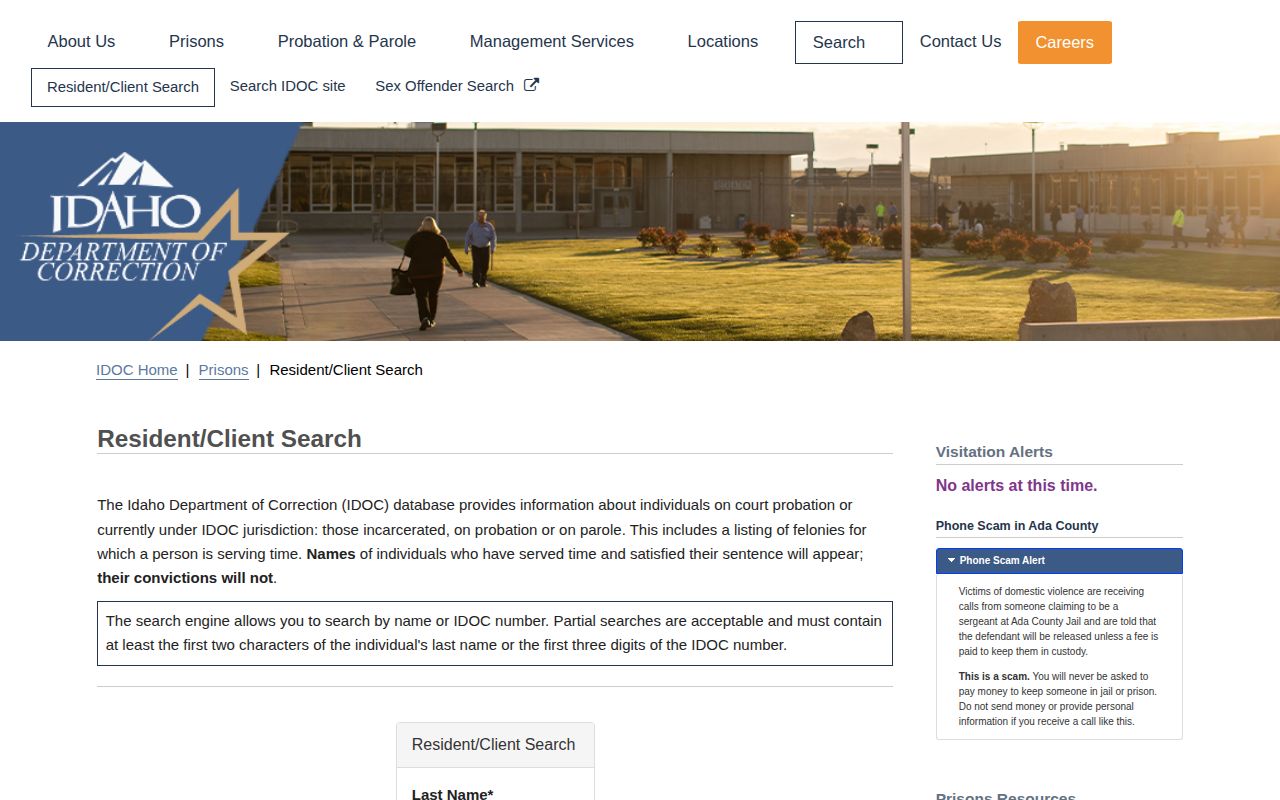
The interface is a public status tool, not a certified sentence computation or release order.
Idaho Fixed and Indeterminate Terms
Idaho does not apply a blanket “serve 85 percent” rule. Under Idaho Code § 19-2513, a court imposes a unified sentence with a fixed minimum term and may add an indeterminate term. The fixed part generally must be served before parole can be considered. Consecutive or concurrent terms, enhancements, mandatory minimums, and offense-specific limits can change the result.
The parole eligibility date ordinarily marks where the indeterminate portion begins. It is an opportunity for review, not a right to release. When several sentences exist, the latest applicable eligibility point can control. The judgment is essential because a public date without the sentence structure can be misunderstood.
IDOC Sentencing Records reviews judgments, applies qualifying jail or retained-jurisdiction credit, processes parole forfeitures, and maintains sentencing data. A request to IDOC is the sound route for the state calculation. The county remains responsible for its own booking and movement record.
Latah County Jail Good Time
County jail time follows a different rule. Idaho Code § 20-621 allows five days per month reduction for good record and task performance, but only on the sheriff's recommendation and a magistrate's allowance. It is not an automatic online subtraction.
A Latah County jail calculation can depend on the judgment, credit for time already served, the actual month calculation, conduct, judicial allowance, other holds, and transfer logistics. Because many non-bond or after-hours detainees are housed in Lewiston, the court, sentencing county, and physical custodian may be different parts of one record trail.
Ask the jail or court for the official calculation. State the case number, sentence date, booking dates, and the exact date field requested. Do not calculate release by counting days from a roster booking card.
Why Latah County Dates Change
A date can move for lawful reasons, or the public site may simply lag. The cause should come from the controlling record.
| Factor | Possible effect | Best confirmation |
|---|---|---|
| Program completion | Delays a conditional parole date | IDOC and Commission record |
| Parole plan approval | Prevents release until approved | IDOC status or formal record |
| Misconduct or revocation | Changes custody and calculation | Commission notice and IDOC |
| Sentence credit correction | Moves satisfaction milestones | IDOC Sentencing Records |
| Warrant or absconding period | May affect full-term calculation | Court and IDOC record |
| Another sentence or hold | Blocks community release | Custodian and issuing agency |
| Online update delay | Shows stale status | Direct agency confirmation |
A court release order gives legal authority, but jail processing and another hold can delay departure. Conversely, a jail movement proves exit from that custodian but may reflect transfer to IDOC, another county, USMS, or ICE. Pair the court order with the completed movement.
Latah County Parole Date Checks
The Commission hearing schedule is posted weekly, with dates and times subject to change. A hearing identifies a pending review. It does not mean release was granted.
After a hearing, the Commission decisions page generally posts a Notice of Action Taken by the end of Friday. A notice may show a grant and tentative date, denial, deferral, continuance, review, or revocation action. Quote the actual notice.
A tentative date can still depend on programming, investigation and approval of the parole plan, and final paperwork. Confirm completed release later through changed IDOC status, a released-to-supervision entry, a VINE or facility event, or a formal state record.
Confirm Latah County Actual Release
For a county event, call the actual custody facility and ask whether the person remains held, left for the community, or transferred. Latah Sheriff's main number is 208-882-2216. Nez Perce custody confirmation is 208-799-3132, and that county expressly warns its online report can lag.
VINE may provide a pending or completed custody notification where the agency participates. Register on the matching person only after checking identifiers. A released or out-of-custody event reflects what the source supplied, but it should still be reconciled with the facility, court, and IDOC path.
For a state calculation or discharge record, use the IDOC public information process. For a local judgment or order, contact the Latah County District Court clerk by case number. The Post-Release Supervision record then answers whether the person remains under parole or felony probation after leaving custody.
Latah County Date Evidence Order
The strongest proof is an agency-maintained movement or release record that identifies the booking, completed event time, event type, and destination. A certified copy may be needed for a formal legal process. The court judgment or release order explains the authority, while the custody event proves how the facility carried it out.
Live agency status and direct staff confirmation come next. They help with urgent checks, but they can change and may not preserve the full event history. VINE alerts and Commission notices are useful operational clues, yet each inherits the source agency's timing and conditions. News reports and copied data are leads only.
This order prevents two common mistakes. A release order does not prove that another hold was cleared, and a jail exit does not prove community release when the destination was IDOC, Nez Perce County, USMS, or ICE. Record the date, time zone, source, and exact label during each time-sensitive check.
Latah County Date Request Details
A precise request saves time. For a jail event, provide the full name, booking number, admission date, court case number, and a narrow date range. Ask for the completed custody movement showing release or transfer time, authority, type, and destination. If the person crossed from Latah booking to Nez Perce custody, direct each county to the portion it maintains.
For an IDOC sentence, include the IDOC number, sentencing county, case number, judgment date, and the official milestone that needs confirmation. Ask Sentencing Records for the calculation or sentence-satisfaction record rather than asking staff to predict an unlabeled release date. For a court matter, request the judgment, bond or release order, sentencing entry, and later satisfaction record from the clerk.
Timing matters. A same-day phone check can answer current custody faster than a written public-record request, while the completed written record provides the better historical account. Keep those purposes separate.